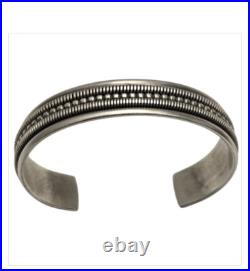
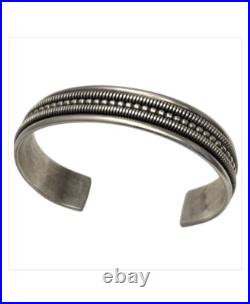
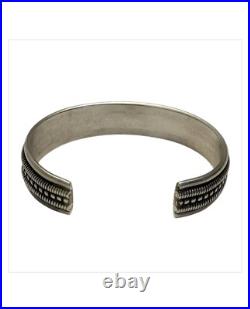
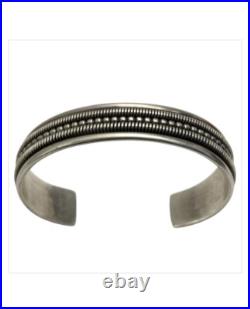
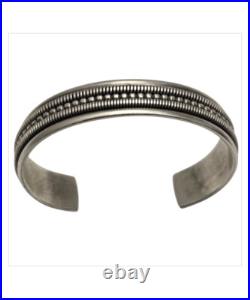
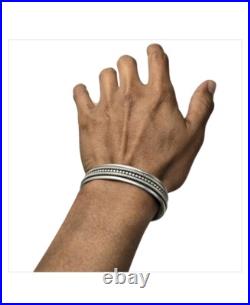
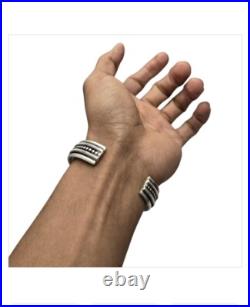

We are proud to offer this fascinating vintage Navajo silver bracelet. This silver cuff really has personality! Created of horizontals of silver rope, and beads the depth and dimension of this piece really catches the eye! The width of the bracelet measures around 14mm The inside end to end measures around 5″½ with an additional 1″? Gap. Sturdy 43.1 grams The Navajo silver bracelet passed from hand to hand, wrist to wrist, generation to generation; silversmith to mother, mother to daughter, daughter to medicine man and medicine man to the needy. Each Navajo silver bracelet has a history. The silversmith’s tools were primitive and few: awls, cold chisels, hammers and rough files. Silver was obtained by melting U. And Mexican coins into ingots, then pounding them into workable sheets. Simple designs were scratched on the surface by rocker engraving… Rocking a short-bladed chisel back and forth while moving it ahead at the same time. Bracelets were also made from casting. Designs were carved into tufa stone molds, then molten was silver poured in and hardened. With increased soldering skills the flat band became more complex. Silversmiths soldered combinations of “triangle bars, twisted round wire and flat bars of various widths” to form new designs. The arrival of the transcontinental railroad in 1880 changed everything. With the railroad came an influx of tourists, traders, The Fred Harvey Company and better tools. Saws, shears, dividers, fine files and emery paper aided silversmiths in creating more refined pieces. Decorative stamps were copied from Mexican leatherworkers and the previously plain, silver bands were now stamped and punched. Tourism brings design shifts to Navajo Jewelry Yet it wasn’t until the turn of the century that a true revolution in Navajo jewelry and the Navajo silver bracelet design occurred. Schweizer realized that travelers wanted lighter pieces to wear in their hometowns of Topeka, San Francisco and Des Moines, so he began to provide precut turquoise, sheet silver and wire to the traders. Traders, in turn, recruited Navajo silversmiths to create jewelry that satisfied the tourist concept of “authentic” Indian design. Harvey House bracelets of the early 1900’s featured thin silver bands, often set with a single turquoise or agate stone, stamped with numerous arrows, swastikas, lizards, thunderbirds and chevrons. Demand soon exceeded supply for Navajo silver and merchants in Albuquerque and Santa Fe began to mass produce items in assembly line shops, often employing non-Native workers. In time there was a backlash against this practice, but original Harvey House bracelets are considered collector’s items today. Another design shift occurred from the 1920’s through the 40’s when new turquoise mines opened in Nevada and Colorado and the beautiful blue green gem became more available. This was a time when Navajo jewelry, and specifically silver bracelets often featured one massive stone with a hand cut, saw-tooth bezel, or one oval stone set in the middle flanked by smaller stones on either side. Many bracelets showcased three large, irregular shaped pieces of turquoise wrapped in twist wire and decorated with silver drops. Zuni style cluster bracelets and multiple row bracelets also became popular with Navajo artists. This was the time of turquoise, turquoise and more turquoise! During this period Navajo jewelry also became increasingly more elaborate. “Baroque” is the word anthropologist John Adair used to describe the complicated designs. Spirals of twist wire, profuse silver raindrops, feather and leaf embellishments and scallop shaped bezels were common. In the late 1930’s the Indian Arts and Crafts Board encouraged artists to return to simpler styles and inaugurated the use of a stamp U. Navajo to signify that a piece was of high quality and Navajo made. Today, one can find any style of bracelet that one desires: silver, gold, cast, ingot, plain, inlay or stamped, with outstanding sets of turquoise, coral and glittering gemstones. From the ultra modern work of Raymond Yazzie to the meticulous Classic style of Perry Shorty, from Harvey House whirling logs to the imaginative, contemporary designs of Darryl and Rebecca Begay, all are available through trading posts, museum shops and art shows across the United States. Yet this is not the full story. The full story of a Navajo silver bracelet lies in the life of its maker, in its wearer, in the history of a trader, in the one who admires it in a window and the one who takes it home. The story of a Navajo bracelet is revealed in the appreciative crowds at Santa Fe Indian Market or those who gaze on the treasures at a Whitehawk Antique Indian show.